
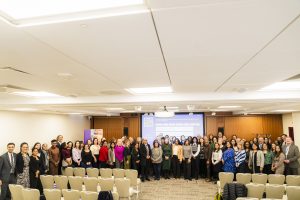
Image of senior leaders and sites from the launch of the Learning and Action Network on the 24th January 2024 in London.
What?
The NHS Race and Health Observatory, in partnership with the Institute for Healthcare Improvement and supported by the Health Foundation, established an innovative peer-to-peer Learning and Action Network (LAN). The LAN aimed to address the inequalities seen in severe maternal morbidity, perinatal mortality and neonatal morbidity for people from Black, Asian and other ethnic minority backgrounds.
Ten teams, from eight Integrated Care Systems, in four regions have participated in an anti-racism focused quality improvement programme. The teams focused on four conditions where evidence highlights significant ethnic inequalities in health outcomes: post-partum haemorrhage; preterm birth; maternal mental health; and gestational diabetes.
Why?
Ethnic health inequalities are a long-standing challenge; Black women remain three times more likely to die during or soon after pregnancy compared to White women and the maternal death rate for women from Asian ethnic backgrounds remains two times higher than that of White women. Babies from the Black ethnic group have the highest rates of stillbirths and infant deaths, with babies from the Asian ethnic group consistently the second highest.
In England, there are few large-scale maternal and neonatal health improvement initiatives aimed specifically at addressing ethnic health inequalities. There are also evidence gaps around organisation-level interventions targeting structural and institutional processes which perpetuate racism and ethnic health inequalities.
Our LAN pilot was based on the assumption that racism is one of the factors responsible for the persistence of ethnic health inequalities. Through this pilot, which viewed racism and racial bias as determinants of health, we aimed to understand whether it is feasible, acceptable and possible to improve maternal and neonatal health outcomes for people from Black, Asian and other ethnic minority backgrounds through an anti-racism focused quality improvement approach.
How?
Between 2023 and 2026, we worked with colleagues from the Institute for Healthcare Improvement and a group of experts drawn from our Maternal and Neonatal Health Advisory Group to develop and deliver an anti-racism focused Quality Improvement programme. By embedding the RHO Anti-Racism Principles in the programme, we aimed to support teams to identify and address racism and racial bias in maternity services.
You can read more about the principles and how to implement them here.
Teams which participated in our network:
|
The LAN programme consisted of improvement coaching, anti-racism webinars, clinical webinars, and online and in-person sessions during which teams shared and develop their learning around quality improvement through an anti-racism lens.
Kate Brintworth - Chief Midwifery Officer for EnglandThis work will help to accelerate local improvements in maternity and neonatal services, helping to ensure safer, more personalised and equitable maternity care for all women, babies and families.
Highlights and reflections
Celebrating impact
What next?
The LAN drew to a close in December 2025. Participating teams have shared their learning and examples of best practice through our Health Action Resource Platform (HARP).
Further resources will shortly be available via the HARP. We also plan to share blogs from participating teams and an infographic overview of the programme in due course.
We have also worked with partners and participating teams to adapt quality improvement tools with an anti-racist lens, such as the Anti-racism Model for Understanding Success in Quality (MUSIQ-AR) and the Anti-racism Model for Improvement (MFI-AR).
An independent evaluation of the programme was carried out by South London Health Innovation Network, UCLPartners, and Race Equality Foundation.
The evaluation assessed the feasibility, acceptability and effectiveness of applying an anti-racism focus to quality improvement interventions, and identified factors important for scaling this approach.
Our evaluation partners also produced guidance which is directly applicable to the evaluation of initiatives aimed at spread, scale and sustainability of the the programme, but also to the evaluation of anti-racism QI initiatives more broadly, including beyond maternal and neonatal health.
We are currently applying learning from this work to the delivery of the Perinatal Equity and Anti-Discrimination Programme (PEADP), while continuing to influence for perinatal health and workforce equity via our maternity and neonatal workstreams and our Maternity and Neonatal Advisory Group.
For further information, please contact: [email protected]